


Online prediction platforms like Raja Luck appeal to many players who seek smarter number and color selection. Although these games use random number generators (RNGs), players often analyze past results to develop strategies. This analysis does not ensure accurate predictions or wins. However, it encourages players to avoid impulsive choices and adopt a more disciplined approach to gameplay.
Past result analysis helps you manage your bankroll and maintain emotional control. This guide shows how to use history tracking to make better decisions while recognizing randomness. Rather than aiming for prediction, the focus is on building a more responsible and strategic approach to gameplay.
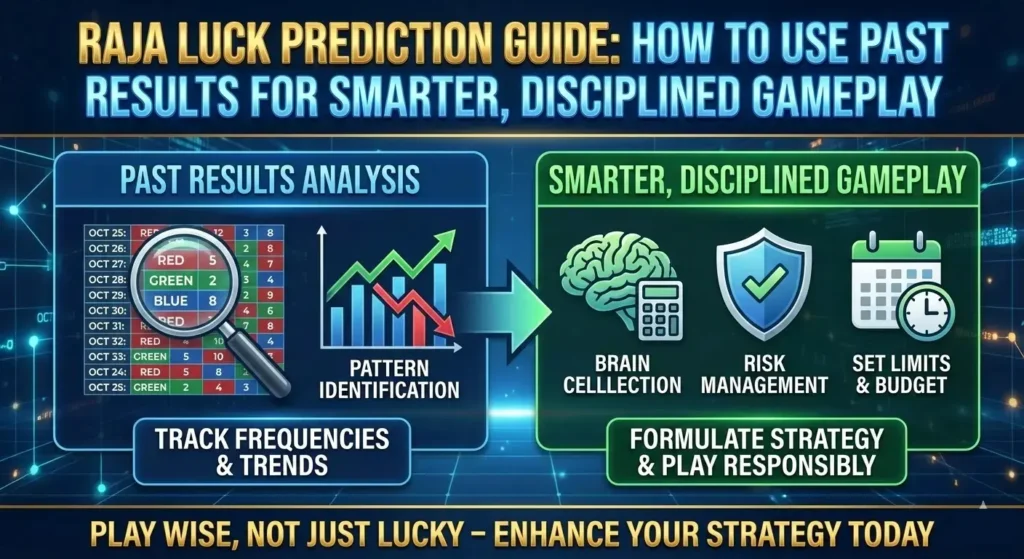
Understanding What Past Results Can & Cannot Do
Players often misunderstand the role of past results in games like Raja Luck. Here are the realistic capabilities and limitations:
What Past Results CAN Help With
- Creating a structured decision-making routine
- Reducing impulsive betting tendencies
What Past Results CANNOT Do
- Predict upcoming colors or numbers.
- Influence or change random outcomes
These points highlight that, while history cannot predict future outcomes, it remains valuable as a tool for discipline and behavioral improvement.
How Raja Luck Displays Past Results
Raja Luck provides previous game outcomes directly within each game interface, usually showing the last 10 to 20 rounds. These round histories appear through easily accessible buttons such as “History,” “Records,” or “Result.” Players typically see the winning color, the number assigned to the color, and the time the round finished. This accessible data serves as a foundation for anyone who wants to track trends on their own.
By recording past results manually, players develop their own sense of trends. Spotting these trends does not guarantee results, but tracking rounds encourages patience and reduces emotional betting. This habit also helps players become more familiar with how the game flows, which supports discipline over time, even in random environments.
The 20-Round Tracking Method Explained.
The 20-round method is one of the simplest and most commonly used approaches among players who prefer structure over guessing. The idea is to collect the last 20 outcomes and analyze the frequency distribution of colors or numbers. When you write down these 20 rounds in a notebook or spreadsheet, you start noticing clusters, repetitions, or imbalances. For example, if red appears 9 times, green 6 times, and violet 5 times, you gain insight into the game session’s short-term behavior.
Even though these observations do not predict the next result, they help define how you want to play. Some players choose to follow the more frequent colors, believing they have momentum, while others prefer to bet on the least frequent colors, assuming they may reappear soon. Both interpretations rely on human psychology rather than mathematical advantage, yet they help players stick to a plan rather than make spontaneous decisions. That alone can reduce rash losses and improve personal performance.
Tracking 20 rounds shows how randomness creates small streaks and trends. By seeing this, players are less likely to be surprised by unusual result sequences, making it easier to accept the unpredictable nature of the game.
Pattern Recognition Techniques in Raja Luck
Many players look for structure by watching for streaks or patterns in numbers and colors. They may see streaks, rotations, or number-color pairings and use them as decision-making frameworks. While patterns do not predict outcomes, they help players stay consistent in their choices.
One type of pattern is streak patterns, where one color appears for several rounds in a row. Players often decide whether to follow the streak or bet against it depending on their temperament. Another pattern is alternation, where colors rotate in short sequences. Observing rotations does not provide certainty, but it helps players feel more in control of their choices.
Some players also examine which numbers appear most commonly with certain colors. Even though such associations are coincidental in RNG systems, they offer another lens through which players design their personal strategies. The idea is not to predict but to create a system that is more stable than random guessing.
Hot vs. Cold Strategy in Raja Luck
One of the most widely discussed approaches among prediction-game players involves identifying hot and cold colors or numbers. Hot colors are those that appear frequently within recent rounds, while cold colors appear rarely. Many players believe in following the hot trend, expecting continued momentum, while others think cold options may eventually reappear.
This strategy, while popular, does not change the fact that every round in an RNG system is independent. Hot or cold streaks in past results do not affect future chances. The real value of the hot/cold method is that it gives a clear structure. Following a system like this helps avoid impulsive bets and supports consistency.
Hot and cold strategies also help players better understand randomness. A long absence of a color does not guarantee its return, but players can still use the observation to set controlled, measured bet patterns that align with their risk preferences.
How to Incorporate Past Results Safely into Your Gameplay
To use past results safely, always keep your play disciplined and controlled. Start with small bets, especially when trying new approaches or analyzing data. Avoid raising your wager quickly, as no method can overcome the randomness of the game.
Tracking success over dozens of rounds gives players a more accurate understanding of whether their system is helping or hindering them. Many players assume their method is effective after only a few wins, but true evaluation requires 100 or more rounds of honest documentation. This process develops patience and a deeper awareness of how randomness behaves.
Adjustments are essential as no single method suits every play session. If your tracked approach shows poor performance after a reasonable number of rounds, small modifications can make a noticeable difference. The objective is not perfection but sustainable play.
Learning to manage finances is equally important. Setting a limit on how much you can risk in a single session helps keep losses under control. Players who stick to a maximum percentage per bet preserve their bankroll much longer, allowing them to gather more data and refine their strategy over time.
Emotional control is another critical factor. Many losses occur not because of poor strategy but because players become emotional, frustrated, or overconfident. Recognizing the signs of emotional tilt and taking breaks helps prevent unnecessary mistakes and helps players regain control.
A Practical and Responsible Example Strategy
A common, simple approach used by many disciplined players involves tracking a set number of recent rounds and basing decisions on observed tendencies. The player begins by writing down 20 rounds, identifying the most frequent color, and placing small, controlled bets on that color for two or three consecutive rounds. If all three bets lose, the player steps away for a break to prevent emotional decisions.
After the break, the player notes the last 20 rounds again to refresh the analysis. This helps the strategy remain aligned with the current game flow rather than outdated data. Small and measured bets maintain safety, while repeated tracking prevents players from relying solely on instinct.
Like all strategies, this method does not increase your chances of winning. Its main purpose is to provide stable, consistent, and emotionally balanced play.
Conclusion
Using past results in Raja Luck is about discipline, not prediction. Systematic tracking, responsible bankroll management, and emotional awareness create a solid foundation for long-term play. While randomness remains, using a structured approach helps prevent reckless choices and enhances the overall experience.
The best long-term approach is to focus on what you control: your strategy, emotions, and bankroll. Consistency and patience are the true strengths in games of chance.