


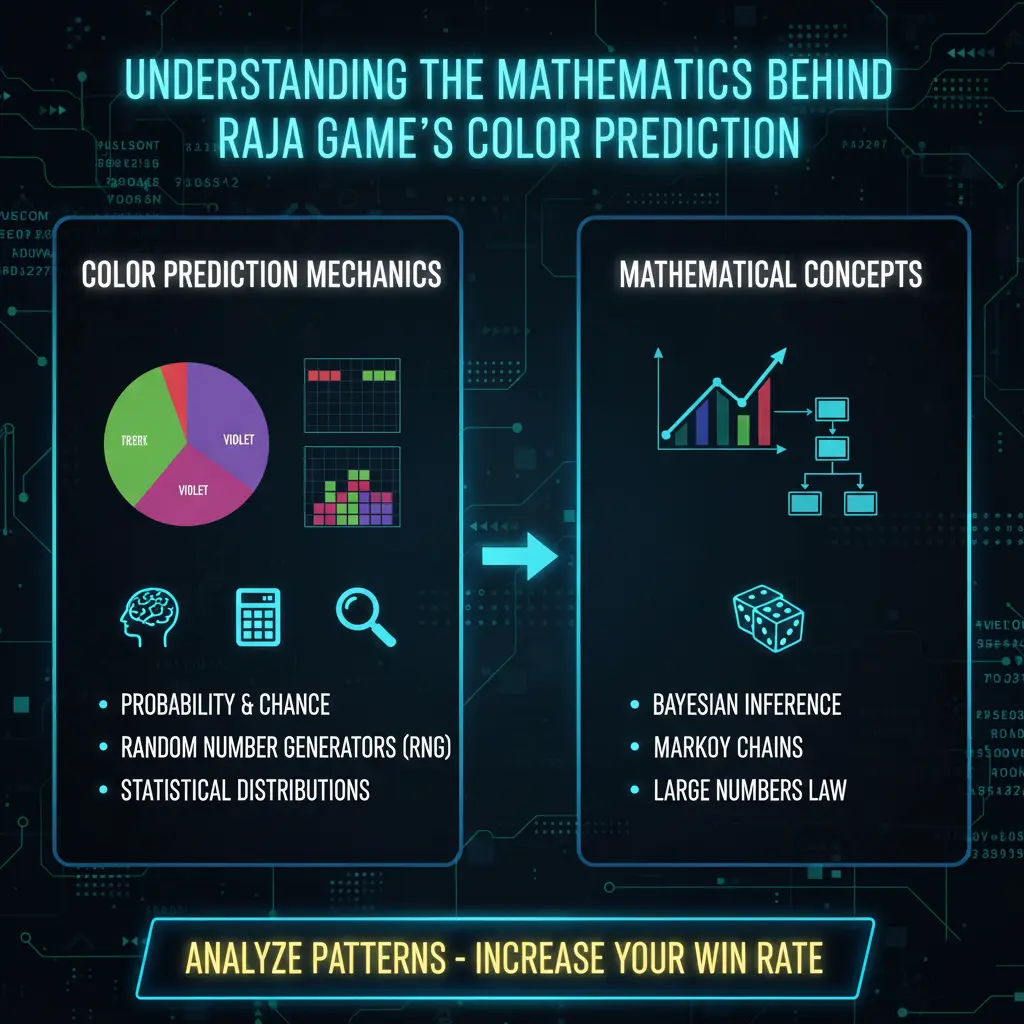
Introduction: The Magic of Mathematics in the Raja Game
At first glance, Raja Games color prediction seems simple: just guess if Red, Green, or Violet will come up next and win if you’re right. But there’s actually a complex math system behind every result. While no strategy can beat the house edge, knowing the math can help you set realistic goals, manage your money, and get the most fun out of the game. This guide covers key topics like Random Number Generation (RNG), probability, the house edge, and why some strategies don’t work while others help you enjoy the game more.
The Core Technology: Random Number Generation (RNG)
Random Number Generation (RNG) is what powers Raja Game’s color prediction. RNG is a computer program that creates random numbers, making each round fair and unpredictable. Each number matches a color Red, Green, or Violet and every round is separate from the last. So, it doesn’t matter how often a color has shown up before; it won’t affect what happens next.
The main point is that you can’t predict what will happen next in Raja Game. Since the game uses RNG, past results don’t affect future ones. Looking for patterns or thinking a color is “due” to appear doesn’t work because every outcome is random and independent.
Probability Theory and Predicting Outcomes
Probability theory explains the chances of each outcome in games like Raja Game. In a perfect world with no house edge, Red, Green, and Violet would each have a 33.33% chance of showing up. But real platforms add a house edge, which changes these odds a bit so the casino can make a profit.
For example, if Red and Green each have a 32% chance and Violet has a 31% chance, this small difference helps the platform make money over time. The Expected Value (EV) of each bet shows that, in the long run, players will lose an amount that matches the house edge.
The Gambler’s Fallacy and Understanding Variance
A common mistake is the Gambler’s Fallacy, which is thinking that if a color comes up several times in a row, it’s “due” to change. But in a game with RNG, past results don’t affect what happens next. For example, Red is just as likely to appear again, no matter how many times it has shown up before. Each round stands alone.
In the short run, you might see winning or losing streaks because of variance. These ups and downs can look like trends, but over time, the house edge means the platform will always profit, no matter what happens in the short term.
House Edge and Betting Systems: Why They Can’t Beat the Game
Every gambling game, including Raja Game, has a house edge. This is the gap between the real odds and the odds the game gives you, and it’s how the platform makes money over time. Many players try betting systems like Martingale, Fibonacci, or D’Alembert to beat the house edge, but these don’t work in games that are all about chance.
Betting systems can’t alter the fundamental nature of the game, which is based on random, independent events. These systems often lead to massive losses in the long run. Betting systems can’t change the fact that the game is random and each round is independent. Often, these systems cause big losses over time because players keep raising their bets to try to win back what they’ve lost. The house edge means that, after many bets, players will still lose money overall. After several consecutive appearances of a particular color (e.g., Red), the game is “due” for a change. However, this pattern-recognition fallacy is nothing more than a statistical illusion. In truly random systems like Raja Game, every round is independent. The occurrence of Red multiple times in a row does not mean it’s “due” for a change this is just random variance.
People naturally look for patterns, even when things are random. This is called the clustering illusion, and it makes us think we see patterns that aren’t really there. In truth, seeing sequences like Red-Red-Green or Red-Green-Red doesn’t tell you anything about what will happen next.
Best Practices: Bankroll Management and Entertainment Focus
Because the game is unpredictable and has a house edge, the best approach is to manage your bankroll carefully. Instead of trying to guess outcomes or use betting systems, stick to flat betting make steady, small bets that fit your budget. Set a spending limit and follow it so you can play responsibly and have fun without risking too much.
It also helps to set goals for how much you want to win or are willing to lose in one session. Decide these limits before you start, and stop playing when you reach them. This way, you avoid making emotional choices and keep the game fun instead of chasing profits.
Conclusion: Embrace the Mathematics, Not the Myths
Learning the math behind Raja Game’s color prediction helps you set realistic expectations and avoid common mistakes. It might be tempting to try patterns or betting systems, but these don’t work because the game is random by design. The best way to enjoy the game is to play responsibly, manage your money, and treat it as entertainment, not a way to make money.
FAQ: Common Questions About Raja Game’s Math
By understanding the math and playing smart, you can have more fun and avoid the common mistakes that catch many players off guard.